

Summary
What’s happening: Africa’s highest-ever solar panel imports shows that (1) Africa’s power demand is growing faster than grids and utility power, (2) consumer solar confidence is outpacing institutional capital, and (3) structurally, risk is shifting to the end consumer.
Parallel opportunity: Paradoxically, two opportunities for RE investors: (1) aggregate, finance, and integrate these systems; and (2) invest to accelerate grid & utility pace
Why now: Where solar imports surge without parallel grid, financing, and regulatory reform, institutional capital is lagging reality; and future entry costs are rising.
Solar surge
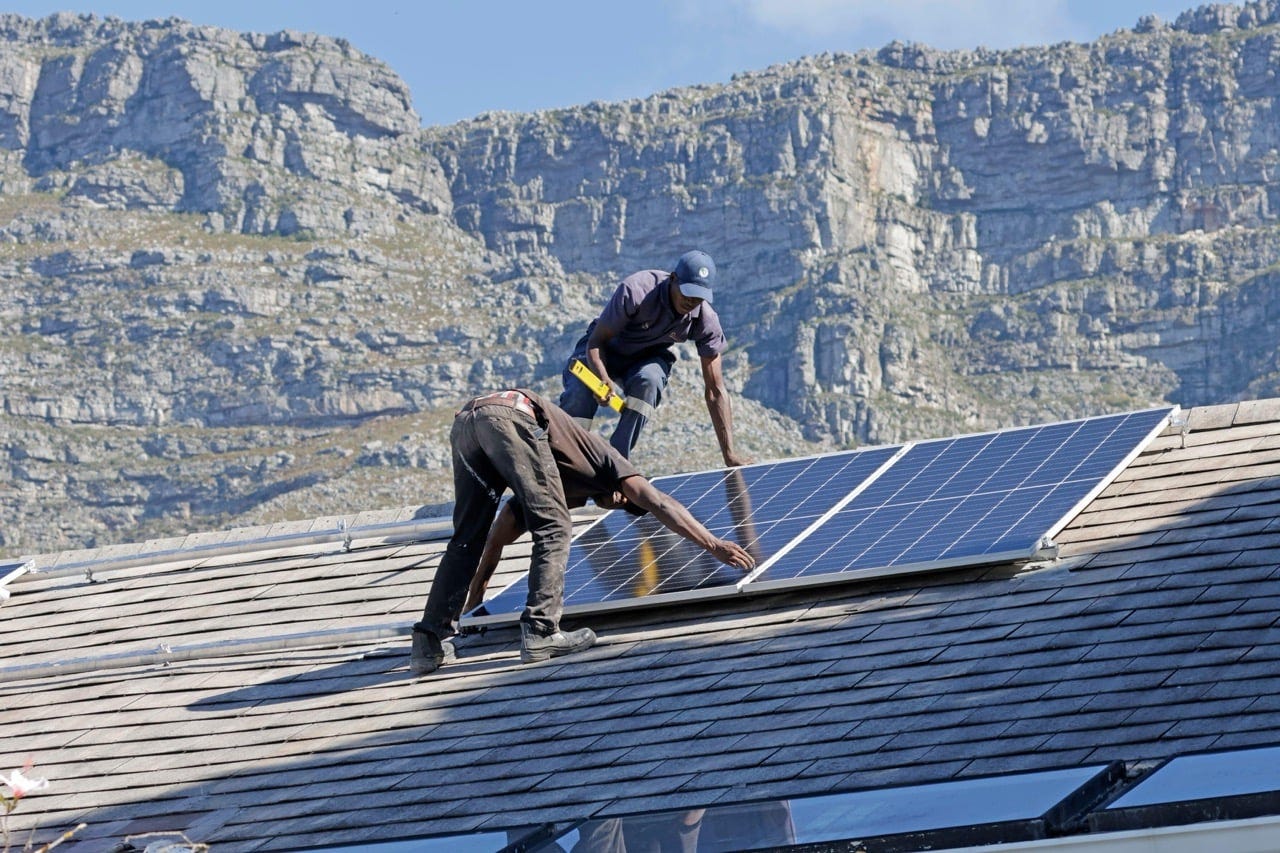
Africa recorded its highest-ever year of solar panel imports in 2025, driven largely by rooftop systems, commercial installations, and off-grid and hybrid setups across East, West, and Southern Africa – according to the Global Solar Council.
On the surface, this looks like a simple climate success story. In reality, it is a deeper signal about how Africa’s energy transition is currently being financed, and where risk is shifting to.
This surge in imports reflects demand that has moved faster than utilities, regulators, and institutional capital. Households, SMEs, telecom towers, farms, and industrial users are increasingly choosing to self-provision power rather than wait for grid expansion, utility reform, or large-scale IPP projects to materialise. In effect, energy risk is increasingly being privately absorbed.
Risk shift
Instead of being carried by public balance sheets, sovereign guarantees, or structured finance vehicles, risk is now shifting to end users in the form of upfront capital costs, performance uncertainty, maintenance obligations, and currency exposure. This is a quiet but important shift in Africa’s energy landscape.
Investor implications
For investors, this carries two contrasting implications.
It sharply reduces technology risk in Africa. High import volumes indicate that solar equipment, installation capacity, and supply chains are now widely trusted. The question of whether solar “works” in African conditions has largely been answered by the market itself.
It exposes unresolved system risk. When consumers bypass utilities at scale, it signals limited confidence in grid reliability, offtake stability, and formal financing structures. Solar is proven. Power systems are not. This immediately reads like a system risk, but for discerning investors it is a system opportunity – investing in grids to catch up to high, growing demand.
Parallel opportunity
The result is a parallel energy economy: decentralised, fragmented, and growing quickly outside traditional infrastructure channels. This creates a paradox that investors should pay attention to.
Africa’s solar market is expanding fastest in environments where institutional capital remains hesitant. Demand is being met, but inefficiently, through equipment traders, informal financiers, and balance sheets not suited to long-term infrastructure risk. Returns exist. They are simply being captured upstream and off-balance-sheet.
Risk: This represents a reallocation rather than a reduction of uncertainty.
Opportunity: Record imports indicate bankable demand without bankable structures. There is a growing base of decentralised assets that lack standardisation, long-term finance, and scalable platforms. Investors able to aggregate, finance, and integrate these systems stand to enter a market that has already been validated by users.
The deeper message is this: Africa’s energy transition is advancing without waiting for institutional capital.
Where solar imports surge without parallel grid, financing, and regulatory reform, institutional capital is lagging reality; and future entry costs are rising.
And it suggests that the next phase of Africa’s renewable non-utility market will be defined less by technology adoption and more by who succeeds in re-intermediating a fast-growing, decentralised energy economy into bankable infrastructure.