

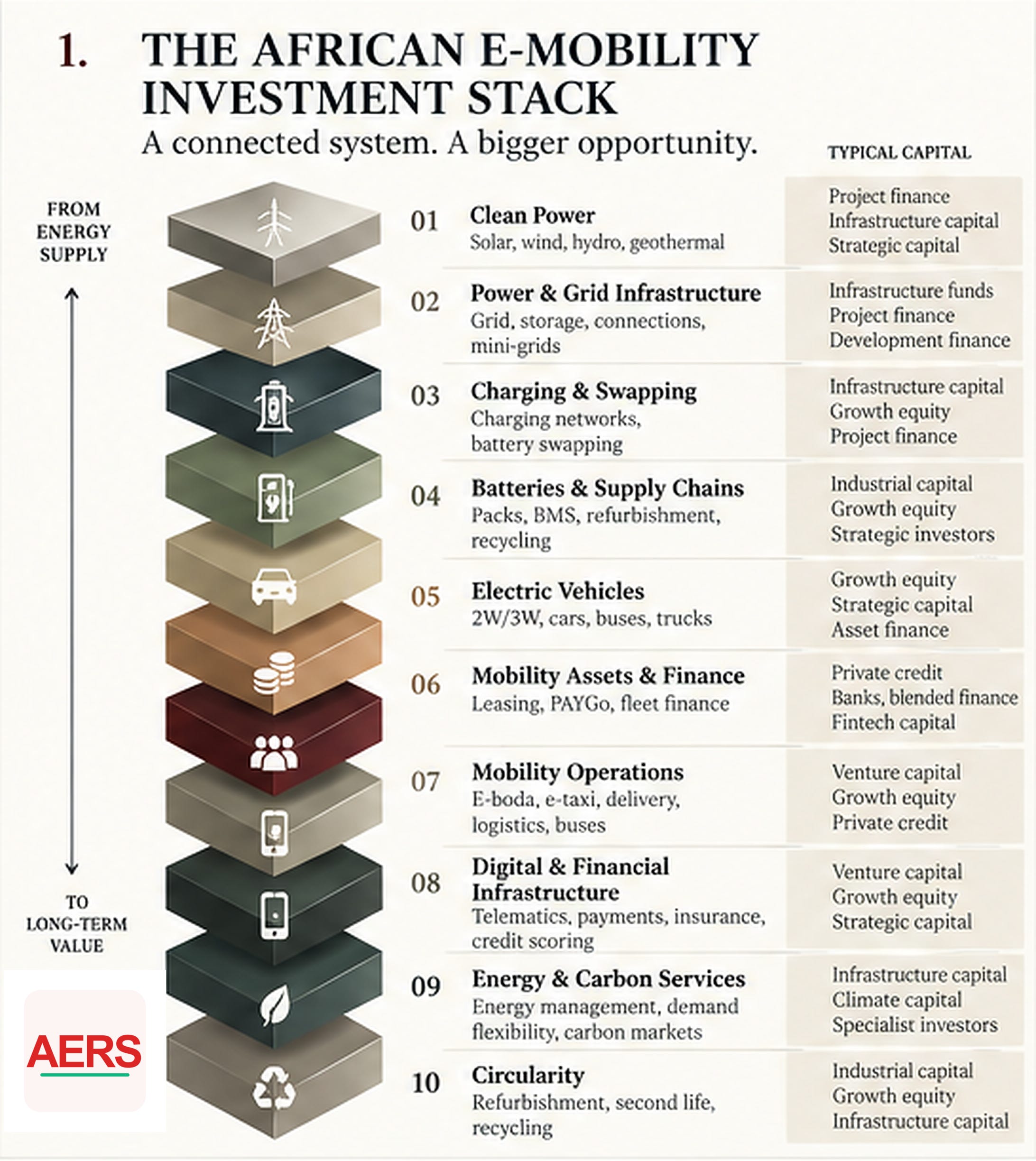
The thesis/framework: The Stack
Size of opportunity and degree of risk determine returns. Investing in electric vehicles presents a smaller opportunity than investing in / bundling more layers in the e-mobility value chain; and greater risk mitigation could be achieved by investing in intersections between layers.
“Investing”
In this memo, “investing” refers not only to financing or project development but also to government efforts (policy, regulations, incentives, infrastructure) to make e-mobility possible and scalable.
Africa’s e-mobility is bigger than the vehicle
The oft-narrow framing – vehicles
Africa’s e-mobility transition is often framed as a question of how quickly electric vehicles will replace internal-combustion vehicles. That framing is too narrow.
Instead, a new economic system
The transition is creating a new economic system — connecting electricity generation, power infrastructure, charging and battery networks, vehicles, finance, mobility operators, digital services and circularity.
The opportunity
The opportunity is therefore not simply the African EV market. It is the investment stack that sits underneath it.
*This is not an argument for replacing public or concessional finance with private capital. Different layers of the transition carry different risk, return and public-value characteristics. Public and concessional capital will remain important where markets are immature, risks are difficult to price, or public goods are involved. The investment question is how different forms of capital can work together; using scarce concessional resources where they are most catalytic, while mobilising other forms of finance where applicable.
For investors
Bundling investment across layers could result in greater returns, economies of scale, negotiation space, and risk mitigation.
For regulators, ministries of energy, and economic planners
Developing the chain as a system could facilitate better capital flow and simultaneously create opportunities to better the country’s energy systems.
E-mobility is a system, not a product
An electric vehicle is only the visible end of a much larger infrastructure system.
Every additional electric motorcycle, taxi, bus or delivery vehicle creates demand for electricity. That electricity requires generation and infrastructure. Vehicles require charging or swapping. Batteries create new manufacturing, financing, refurbishment and recycling requirements.
And because many African mobility markets are commercially operated — particularly two- and three-wheelers — electrification also creates opportunities in asset finance, fleet management, payments, insurance and data.
By the way, insurance and asset financing for electric vehicles creates a different business model from those of petrol/diesel vehicles – evidence that e-mobility creates a different economy as it grows.
The system is therefore interconnected:
Mobility demand → vehicles → batteries → charging/swapping → electricity → finance → operations → data → circularity
Investment in one layer can create demand in several others. And because the system is interconnected, constraints in one layer constrains other layers.
This is the central proposition of the Investment Stack.
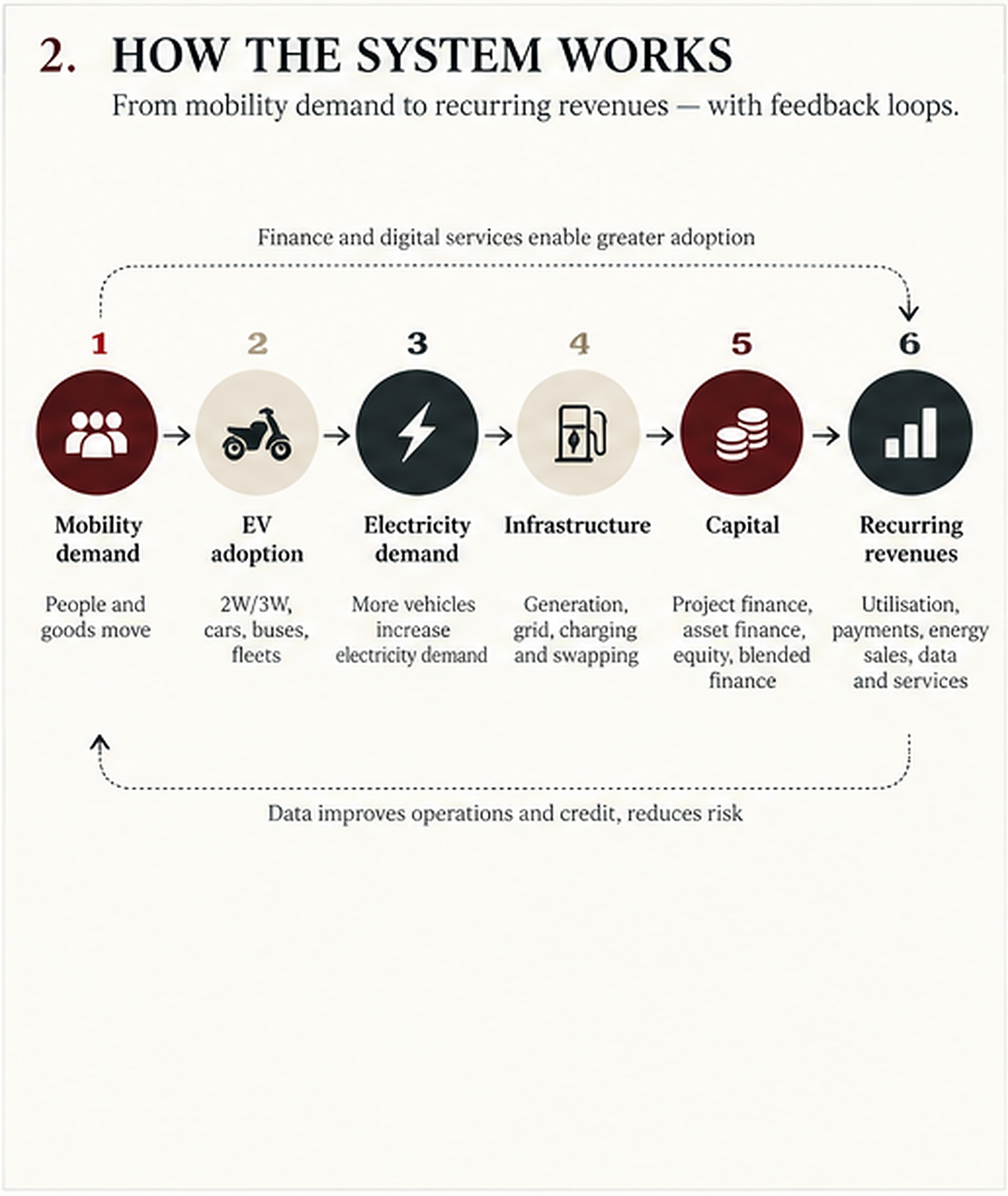
Africa is already providing evidence that this system is beginning to form.
The International Energy Agency estimates that African electric two-wheeler sales reached approximately 70,000 in 2025, up from fewer than 1,000 in 2020. Kenya exceeded 25,000 electric two-wheeler sales, while Uganda exceeded 30,000. African electric car sales were approximately 25,000 in the same year.
The important signal is not simply the number of vehicles but the emergence of repeatable ecosystems around them.
The African investment stack
The stack can be understood through ten interconnected layers.
1. Clean power
Solar, wind, geothermal and other renewable generation provide the electricity that ultimately powers the mobility system. This creates opportunities for dedicated renewable supply, corporate PPAs, distributed generation and energy-as-a-service.
Capital: project finance, infrastructure capital, strategic capital.
2. Power & grid infrastructure
Electrification adds load to already-constrained power systems (African grids face significant constraints). The opportunity therefore extends into grid reinforcement, connections, mini-grids, battery storage, energy management and behind-the-meter systems.
Capital: infrastructure funds, project finance, development finance.
3. Charging & swapping
Africa may not follow a single charging model.
Commercial two- and three-wheelers can create demand for high-utilisation battery-swapping networks, while cars, buses and logistics fleets may require depot, workplace, destination and fast charging.
The infrastructure model will vary by vehicle, geography and utilisation.
Capital: infrastructure, growth equity, project finance.
4. Batteries & industrial supply chains
Batteries are both a technology constraint and an industrial opportunity.
The stack includes mineral processing, battery packs, battery management systems, refurbishment, diagnostics, second-life applications and recycling — even where cell manufacturing remains limited.
Capital: industrial capital, growth equity, strategic investors.
5. Electric vehicles
The vehicle layer spans very different markets: motorcycles, three-wheelers, passenger vehicles, light commercial vehicles, buses and trucks.
Africa’s transition is unlikely to occur uniformly across these segments.
Economics are the prevailing demand driver: Commercial two- and three-wheelers are already emerging as an important early electrification market because utilisation is high and operating economics can make fuel savings material.
Capital: growth equity, strategic capital, asset finance.
6. Mobility assets & finance
For many African operators, the major barrier is the upfront cost rather than willingness to adopt an electric vehicle.
This necessitates an investment layer around leasing, PAYGo models, fleet finance, battery-as-a-service and other forms of asset-backed financing.
Finance is therefore not simply an enabler of the transition. It is part of the infrastructure of the transition.
Capital: private credit, banks, blended finance, fintech capital.
7. Mobility operations
The value of an electric vehicle is ultimately realised through utilisation.
This creates opportunities in e-boda, e-taxi, delivery, logistics, bus and industrial fleets.
Operators that combine vehicle access, financing, charging and digital management may capture value that is invisible when e-mobility is viewed purely as vehicle sales.
Capital: venture, growth equity, private credit.
8. Digital & financial infrastructure
Telematics, fleet management, payments, insurance, credit scoring and mobility data become increasingly important as fleets electrify.
Digital infrastructure can connect the physical layers of the stack while creating recurring revenue streams.
Capital: venture, growth equity, strategic capital.
9. Energy & carbon services
Electrified fleets can become significant electricity consumers.
This creates potential opportunities in energy management, demand flexibility, and avoided petroleum imports. The economics will depend heavily on market design, electricity systems and the ability to measure these benefits.
Capital: infrastructure, climate capital, specialist investors.
10. CIircularity
Electrification creates a new material flow.
Batteries eventually require refurbishment, repurposing, second-life applications and recycling.
The companies capable of extending battery life, recovering valuable materials and managing end-of-life assets may become important infrastructure players in the mature e-mobility ecosystem.
Capital: industrial, growth and infrastructure capital.
The stack changes the investment question
Once e-mobility is viewed as a stack, the central investment question changes. It is no longer simply: *How many EVs will Africa adopt/sell? Instead: Where will value accumulate as the system develops?
Some layers require large upfront capital but can produce long-duration infrastructure revenues. Others are asset-light and may scale through software, finance or network effects. Some are dependent on other layers developing first. Others can act as catalysts for the rest of the system.
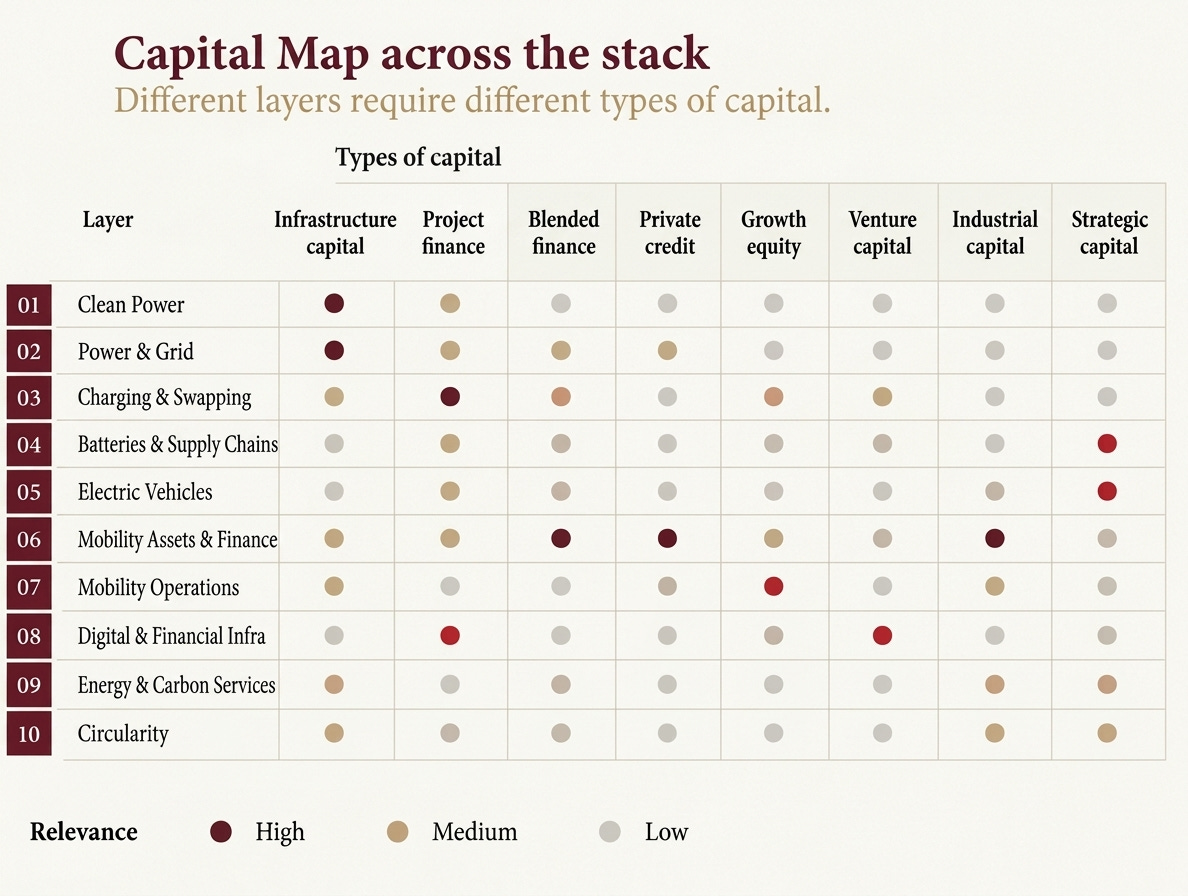
This produces a more useful way of looking at the system. It surfaces useful questions to guide both government and commercial investment:
The bottlenecks
→ Where is infrastructure constraining adoption?
The enablers
→ Which businesses make adoption easier or cheaper?
The capture points
→ Which layers can capture recurring revenue?
The capital match
→ What type of capital is appropriate for each layer?
The African value
→ Where in the value chain can Africa capture value beyond importing vehicles and batteries?
*These questions are more important than a single headline market-size number.
Africa will not [necessarily] reproduce the developed-world pathway
The African e-mobility stack is unique and reflects the structure of African mobility itself.
In many African markets, two- and three-wheelers are central to commercial transport. Vehicle utilisation can be high. Consumer purchasing power is constrained. Credit is expensive. Electricity systems are uneven.
Formal charging infrastructure is limited. That creates a different pathway for Africa from developed countries’ pathways.
The early system may look less like: private car → home charger → public fast charging; and more like:
commercial motorcycle → battery financing → swapping network → distributed renewable power → fleet platform → digital payments → insurance → battery second life
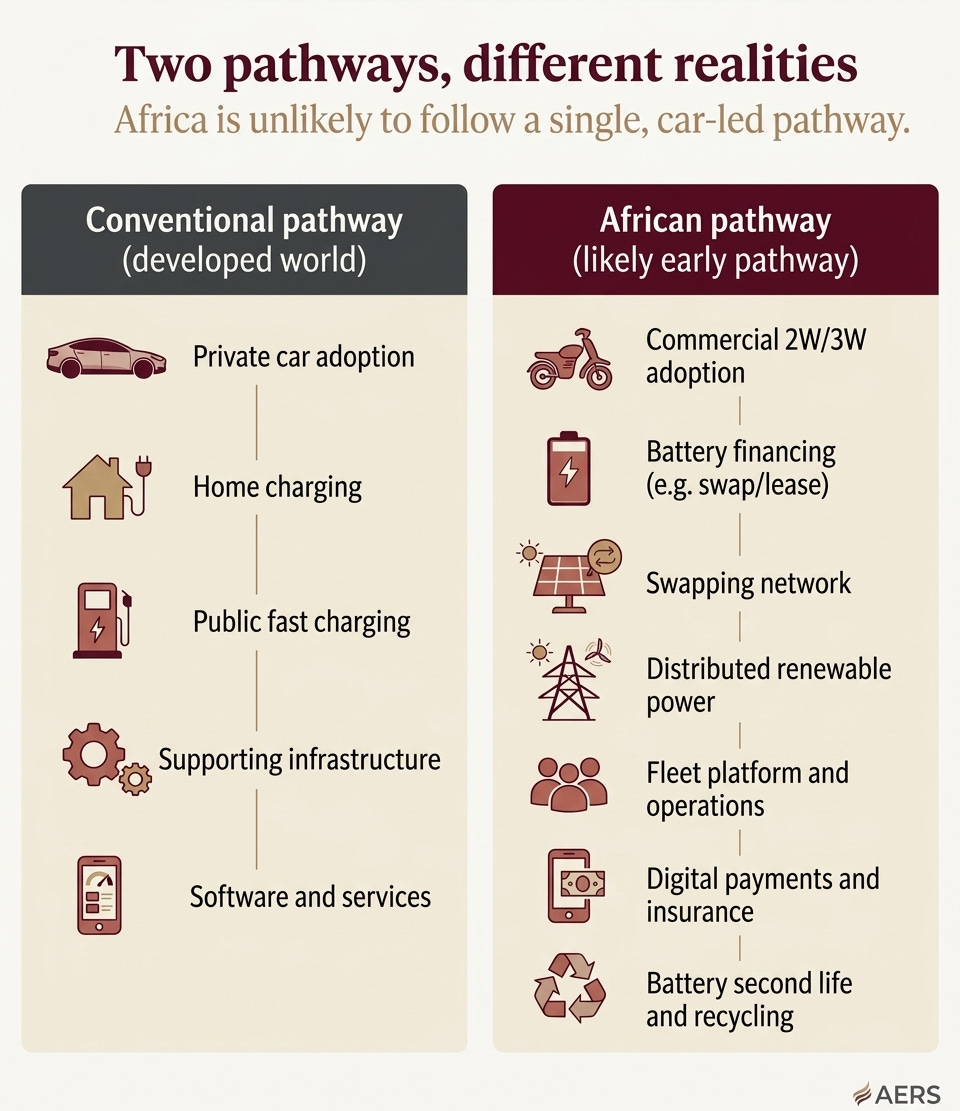
This distinction matters because it changes where investors should look.
A charging company may actually be an energy infrastructure company. A battery company may also be a financing company. A fleet operator may also be a credit platform. A mobility fintech may ultimately become an asset-finance business. The boundaries between sectors begin to disappear.
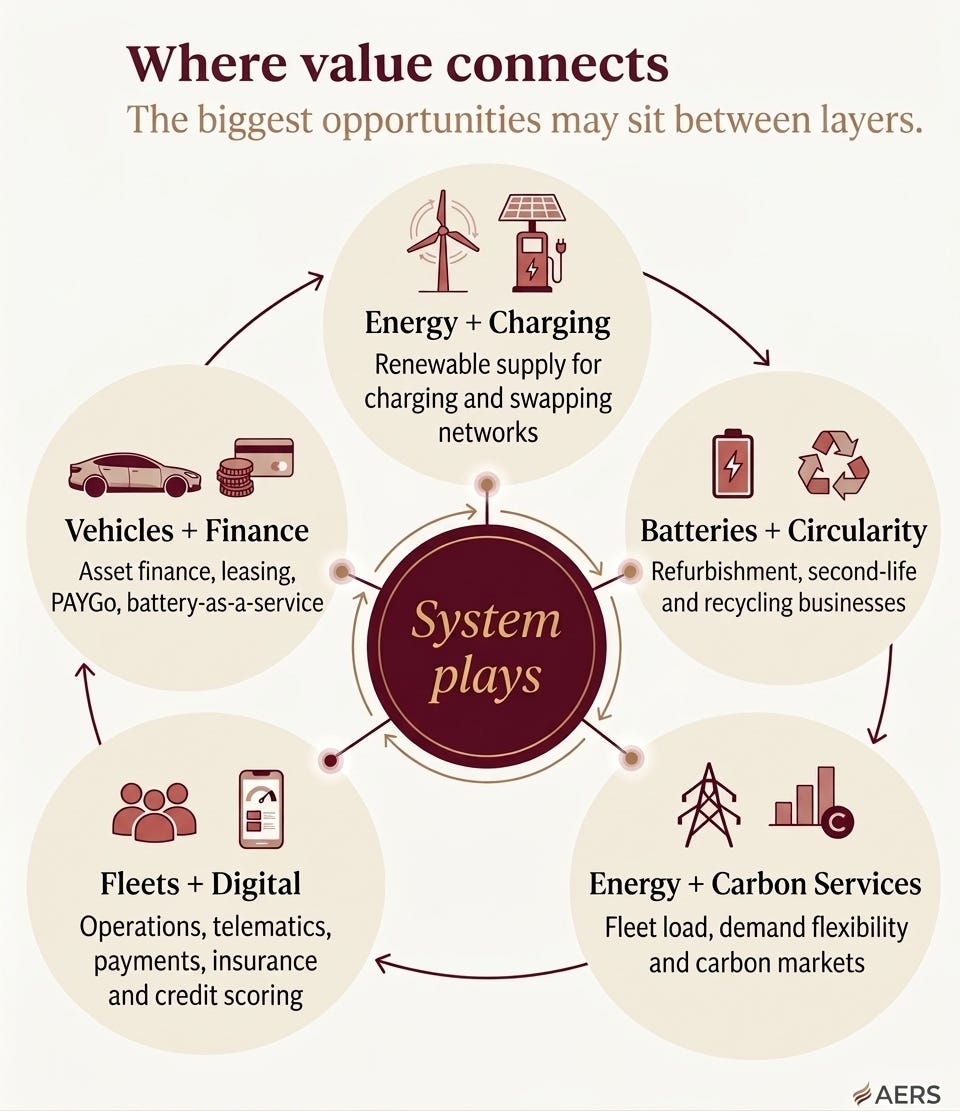
The investment/financing/policy opportunity is in the intersections
The greatest opportunities may not sit neatly inside individual layers. They may sit between them.
Connecting these can potentially solve multiple constraints simultaneously:
energy + charging
vehicles + finance
batteries + finance
fleets + digital infrastructure
batteries + circularity
This is why the African e-mobility opportunity should be understood as a system rather than a vehicle market.
The investment lens
Africa’s e-mobility transition is still early.
That means the question is not simply which companies will sell the most vehicles.
It is:
Who will build the infrastructure that makes electrified mobility economically viable at scale?
Who will finance the assets?
Who will supply and manage the energy?
Who will own the stakeholder relationships?
Who will capture the recurring revenue?
Who will build the industrial capacity around batteries and vehicles?
Who will manage the materials when those batteries reach the end of their first life?
The answers will determine where value accumulates across the African e-mobility stack.
The opportunity is therefore not one market. It is a system of interdependent markets; and a new investment landscape is forming across them.
*Note on the numbers
This briefing deliberately focuses on the structure of the investment opportunity rather than presenting a single headline market-size forecast.
What comes next
This memo establishes the architecture of the African E-Mobility Investment Stack. The next stage of the work will test the scale of capital required across its layers, the risks that constrain investment, and the points at which different forms of capital can interact to improve bankability.
The questions are therefore not only how many electric vehicles Africa could deploy, but where value will accumulate, where risk will concentrate, and how the investment architecture might need to evolve alongside the market.
The AERS team