

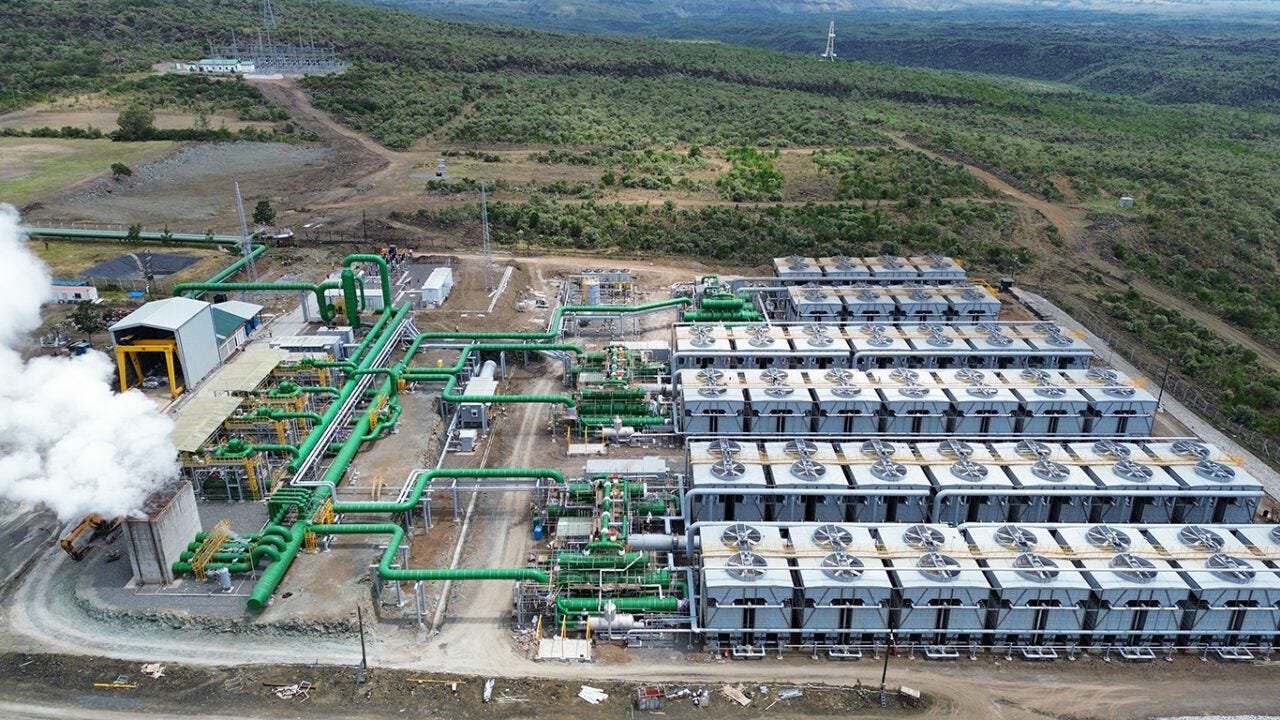
Beyond Menengai
This memo on Menengai is not about Menengai. Neither is it about geothermal, even though it is about geothermal. The Menengai projects are a masterclass in derisking renewable energy projects which are traditionally state-dominated and high risk. They are also reflective of how innovative structuring can overcome stacked risks in renewable energy in Africa (African markets are very nuanced). These Kenyan geothermal projects (“Menengai”) leveraged public finance to mobilize private finance to the ratio of 1:2+, rare for this class of projects.
The Menengai model is a breakthrough. Due to its success, the model has birthed the Kenya National Geothermal Strategy, 2026–2036. This means that the model will be replicated across a number of geothermal projects. We expect that the stacking / model will be used across other investments – solar, wind, hydro, further creating billions of dollars of investment opportunities in Kenya ($600B opportunity over the next 24 years – according to the Kenya Energy Transition & Investment Plan) and in other countries – due to the replicating nature of African markets.
Risk Context
5 endemic risks have curtailed geothermal (and other renewable) investments in Africa for decades:
Drilling risk. You can spend $5M per well with a high probability of finding nothing. Commercial lenders almost never touch this phase, and private equity demands astronomical returns to cover it.
Offtaker risk & liquidity risk. Even if the plant works, the sole buyer (KPLC) is often perceived as fiscally fragile. Investors fear “payment delays” that could trigger a debt default on their own project loans.
FX risk. Energy is sold in local currency (KES), but the debt is often in USD. A 10% currency slide can wipe out an investor’s entire equity return overnight.
Political risk. A new administration might decide the feed-in tariff was too high or try to renegotiate the 25-year contract.
High cost of capital. African projects are often hit with a 300–500 basis point “Africa premium” just for being on the continent.
Menengai solution
The Menengai model has addressed the 5 endemic risks by stacking various derisking instruments & mechanisms as follows:
Drilling risk. The state-owned Geothermal Development Company (GDC) absorbed the exploration risk using concessional funding from the African Development Bank (AfDB). Private IPPs like Globeleq were engaged once the steam was proven. This effectively flips geothermal from a speculative “mining” bet into a standard infra project.
Offtaker risk & liquidity / FX risk. The Regional Liquidity Support Facility (RLSF) provided by ATIDI is a revolving standby letter of credit that acts as a 6-month cash buffer. If KPLC hits a cash-flow crunch, the project draws from the RLSF to stay current on its debt.
Political risk. By securing Breach of Contract (BOC) coverage from MIGA, a local contractual dispute is elevated into a World Bank-level event. It puts the risk of default on a global balance sheet, making it incredibly painful for any local government to walk away from its obligations.
High cost of capital. By blending commercial debt with low-interest loans from the Clean Technology Fund (CTF), the overall WACC is dragged down. This allows the project to sell power at competitive baseload tariffs (around $0.07/kWh), making it both politically and economically defensible against cheaper, dirtier alternatives.
Leverage stacking
By using roughly $145 million in public/concessional finance to de-risk the “unbankable” parts of the project, the Kenyan government + AfDB unlocked over $300 million in private investment and commercial debt for the three IPPs: Globeleq, Sosian, and OrPower 22. The public-to-private finance mobilization ratio was about 1:2, a very high ratio globally. Here’s the rest of the stack and what it unlocked.
Risk implication
This stacking model turns geothermal projects from state-controlled to private participation while mitigating risks for both the sovereign and investors. Specifically, it has changed geothermal projects from mining traps – risky, monolithic, slow business – to a modularized model with multiple revenue streams.
For decades, state utilities like KenGen carried the entire chain—from the high-stakes “mining” risk of drilling $5 million dry holes to the massive capital expense of building the plants. This vertically integrated approach meant that projects only moved at the pace of the national budget or when a major multilateral provided a sovereign guarantee. Private investors largely stayed on the sidelines, held back by geological uncertainty and the “all-or-nothing” nature of early steam exploration.
The structural shift at Menengai changed the business by unbundling these risks into a horizontal market. By having the Geothermal Development Company (GDC) absorb the upstream exploration risk using concessional funding, Kenya effectively mitigated risk for the private sector. Instead of a speculative bet, an IPP like Globeleq now enters a plug-and-play field where the steam is already proven. This modular approach, separating steam supply from power generation, allows multiple private players to build simultaneously, dragging down the cost of capital and turning geothermal into a bankable, institutional-grade asset class.
Replicability implication
This stacking model turns geothermal projects from state-controlled to private participation while mitigating risks for both the sovereign and investors. Specifically, it has changed geothermal projects from mining traps – risky, monolithic, slow business – to a modularized model with multiple revenue streams. We know that variations of this model will be replicated across different projects in geothermal, wind, solar, hydro – in Kenya and in other countries across Africa. Therefore Mennengai, or its model, is in this sense a breakthrough, providing a risk allocation structure that can inspire countries in Africa to turn “risky” projects into asset classes, opening billions in investment opportunities in renewable energy projects across Africa.